
Compact HPL Partition Prices in Cairo
Most people asking this question have already called three suppliers and been given three answers that do not resemble each other. One quoted per square metre, one quoted per cubicle, and one would not quote at all until someone came to site. Here is why that happens and what the Cairo market actually looks like in 2026.
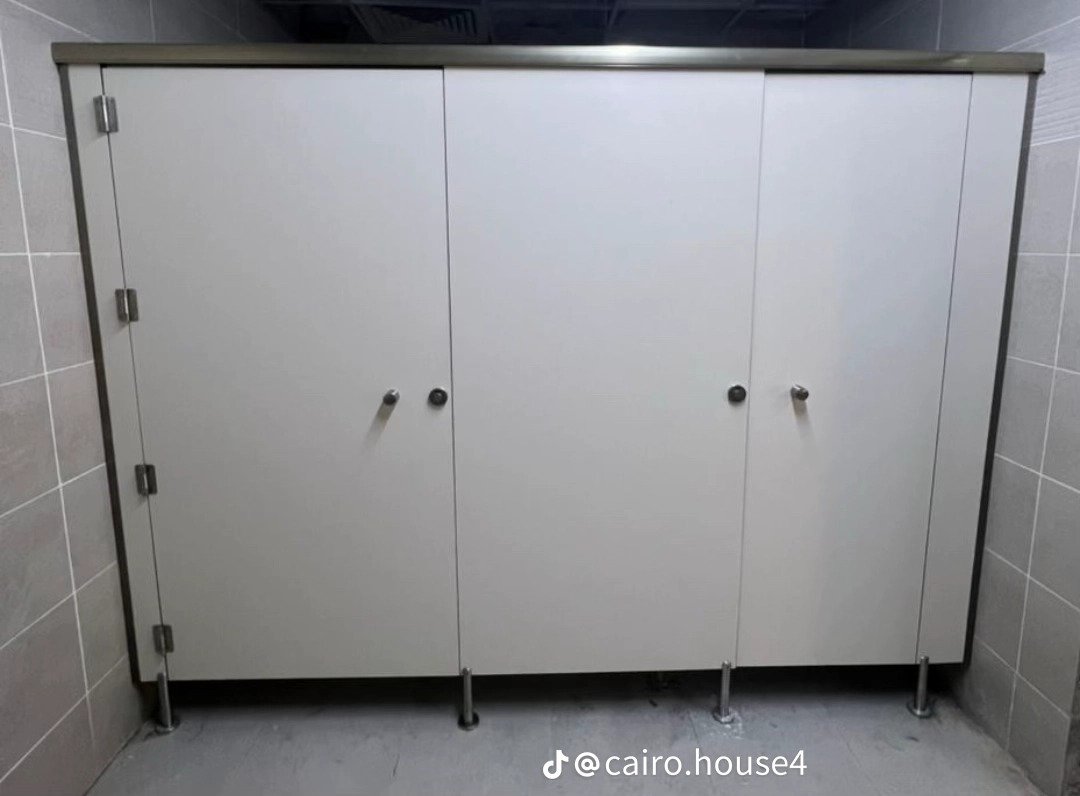
What actually decides the price
Seven things move the number. Panel origin is the largest, and it is the one nobody explains properly.
This sits alongside our main page on compact toilet partitions, which covers the systems themselves rather than the material behind them.
Panel origin
Chinese, Indian and European panel are three different price bands for the same nominal product. Published Egyptian figures put Indian around 5,800 EGP per square metre and Chinese around 5,200 for finished partitions. European sits above both and most suppliers quoting it will not print a number.
The gap is not arbitrary. It shows up in press consistency, colour stability under sunlight, and how the edge behaves after two years of cleaning chemicals.
Panel thickness
12 mm is the Egyptian default and it is what you will be quoted unless you ask otherwise. 13 mm is the sensible specification for genuinely heavy traffic, which in practice means malls, stadiums, transport hubs and factory changing rooms running three shifts.
Every competitor page in this market names thickness as a price driver. Not one of them tells you what the step costs.
Hardware grade
Stainless steel 304 hinges, legs and locks against nylon or PVC equivalents is a real spread, and it is where cheap quotes hide. A cubicle that looks identical on day one behaves very differently at month eighteen. Nylon hinges in a humid washroom sag. PVC legs in a floor that gets hosed down fail at the base.
Ask which grade the quote assumes. If the answer is vague, the answer is nylon.
Fixing system
Floor mounted on adjustable feet, floor to ceiling with a head rail, or a European style concealed suspension system. Each carries a different labour cost and a different bracket cost. The concealed system looks better and costs more.
Quantity and panel yield
This is the mechanism behind the bulk discount that everyone mentions and nobody explains. Panel arrives in a fixed sheet size. Your cubicle widths decide how many doors and dividers come out of one sheet and how much becomes offcut.
Six cubicles at a width that nests cleanly into the sheet cost meaningfully less each than six cubicles at an awkward width. That is why a supplier who has seen your drawings can quote sharper than one working from a phone call.
Site condition
Out of level floors, walls that will not take a fixing, existing plumbing in the wrong place. Adjustable feet absorb a certain amount. Beyond that, someone is packing, shimming or re routing a soil pipe, and that is labour.
Finish
Plain solid colours are the base. Wood grain, stone and marble effect finishes sit above them. Textured and anti fingerprint surfaces above those. The difference between a plain white cubicle bank and a marble tone one is real money on a large job and almost nothing on a small one.
Cairo price ranges in 2026
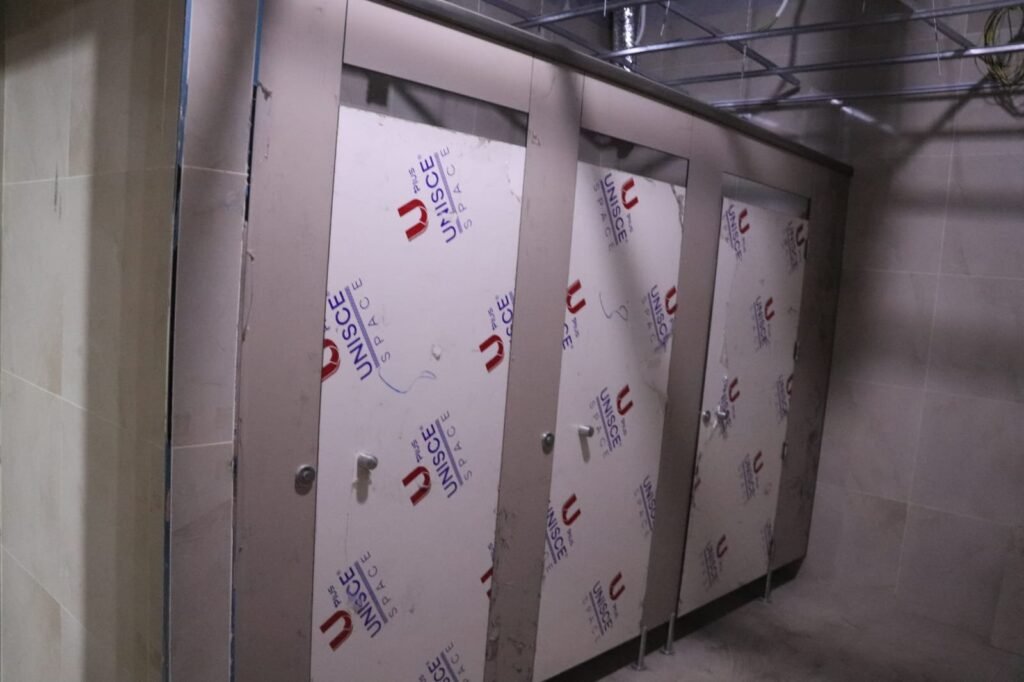
These are published market ranges collected from Egyptian suppliers, not our quote. We have set them out so you can see the spread for yourself.
| Tier | Typical specification | Published market range |
|---|---|---|
| Economy | Chinese panel, 12 mm, plain colour, basic hardware | From about 1,500 EGP per square metre |
| Mid range | Chinese or Indian panel, 12 mm, standard finish, stainless hardware | About 2,000 to 4,500 EGP per square metre |
| Upper | Indian panel, 12 to 13 mm, decorative finish, 304 stainless throughout | About 5,200 to 5,800 EGP per square metre |
| Premium | European panel, 13 mm, concealed system, bespoke finish | Above 5,800 EGP per square metre, quoted on drawings only |
Installation and accessories are commonly quoted as a separate line, and published figures for that sit around 500 to 1,000 EGP per metre.
Every number above is supply of the panel unless the quote says otherwise. If a supplier gives you a single figure and does not say whether installation sits inside it, that is the first question to ask.
Figures move. Ask any supplier, including us, when their price was last reviewed.
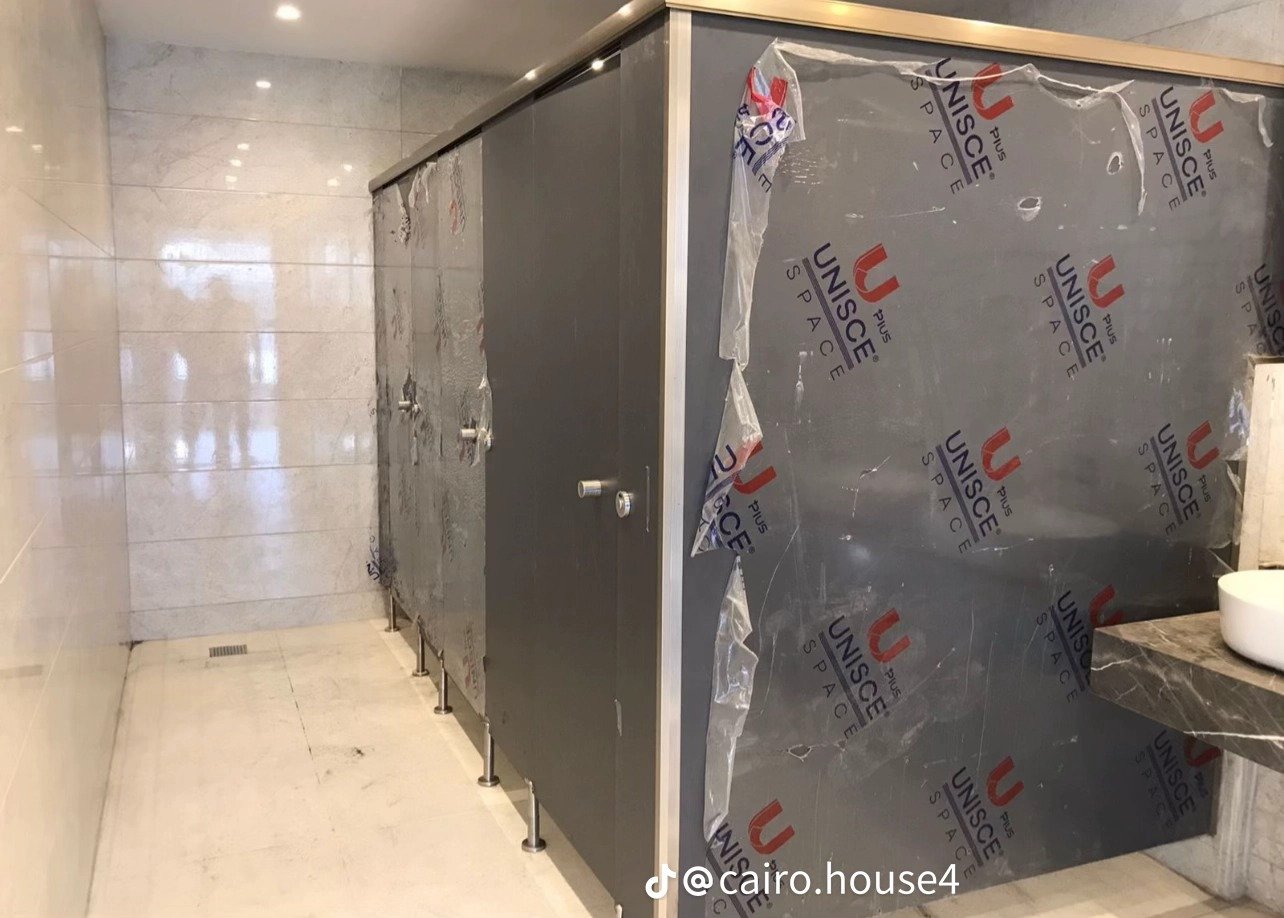
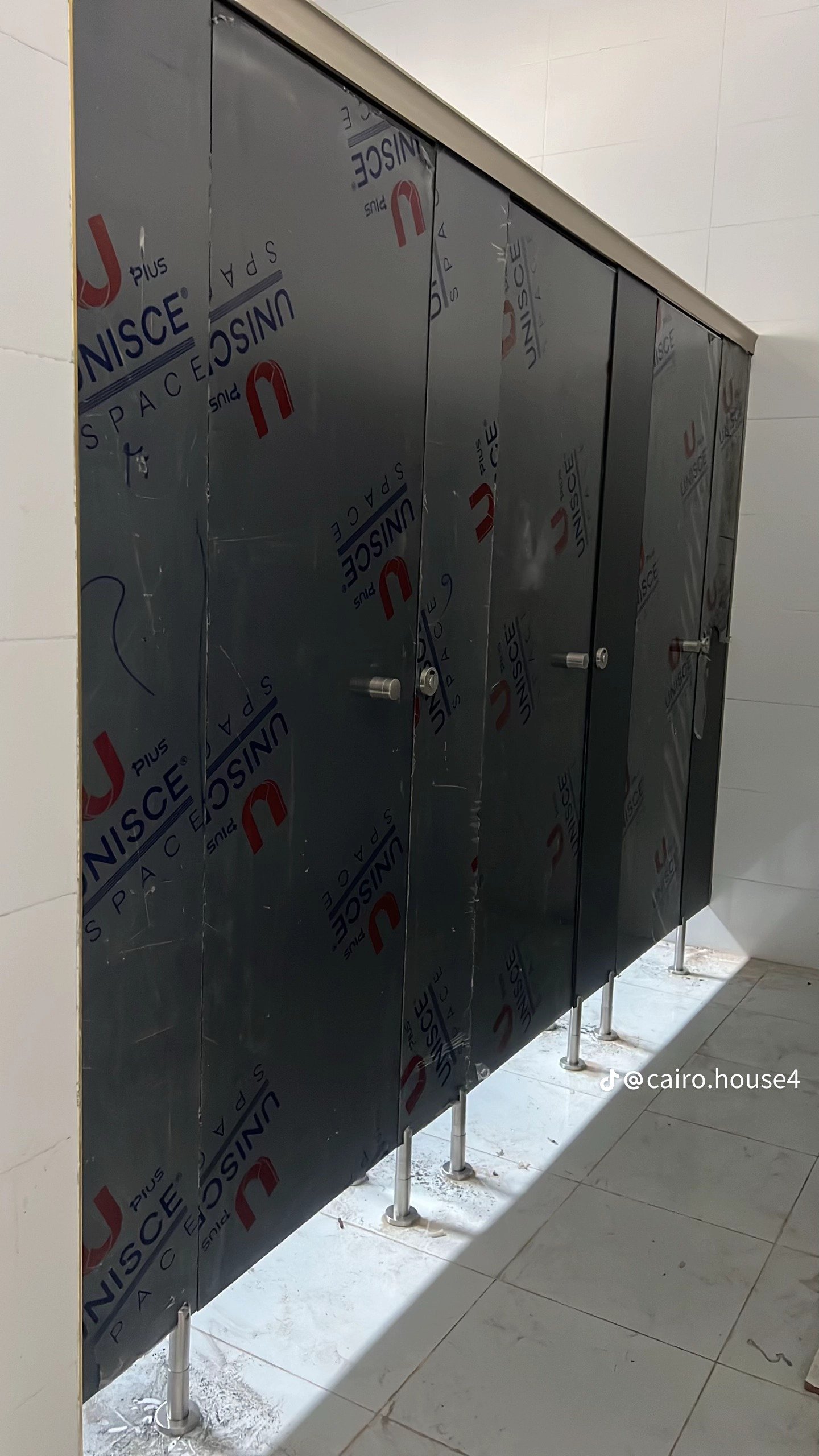
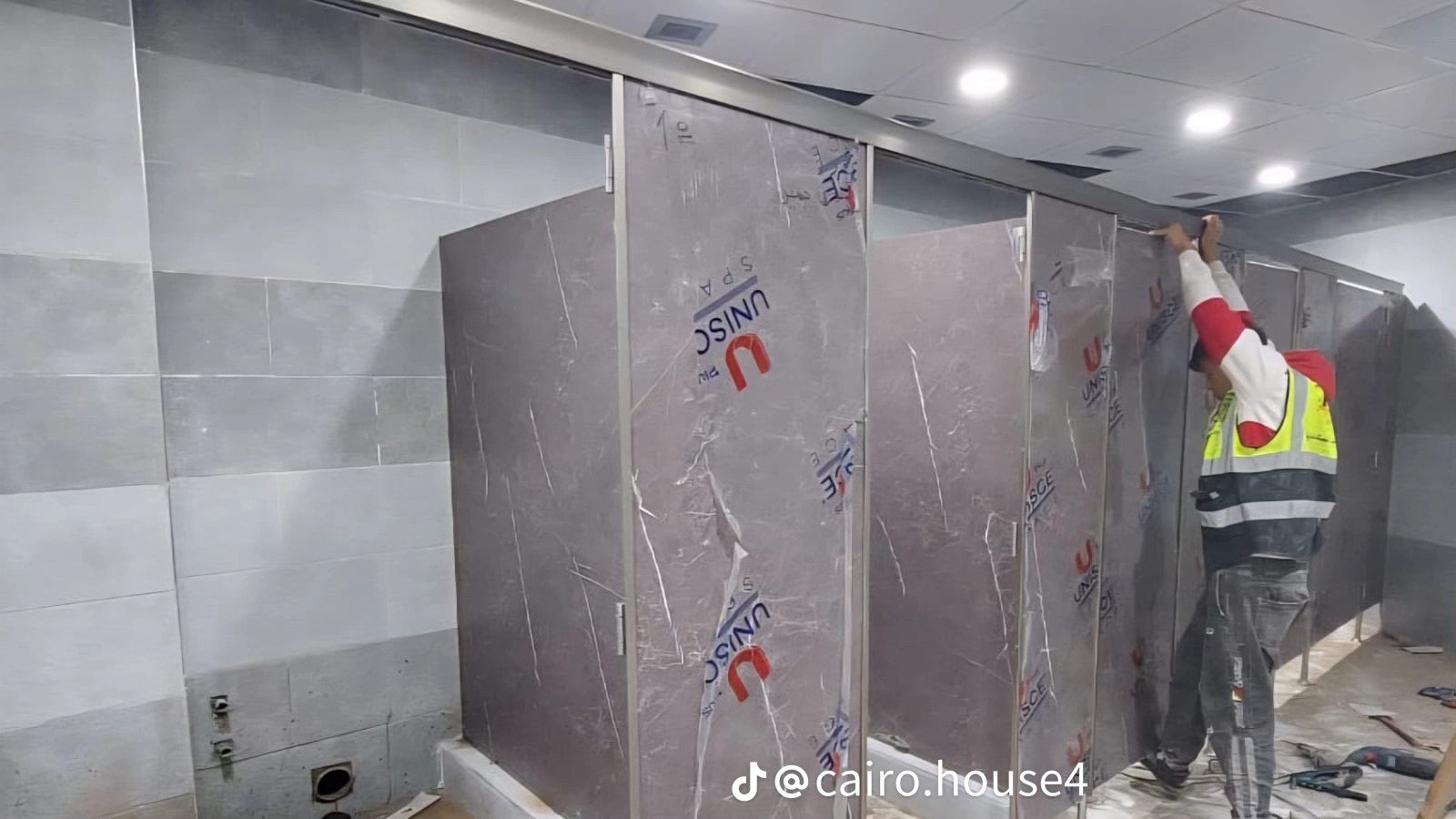
Why one supplier says 700 EGP and another says 5,500 EGP
Because they are selling two different products with the same three letters on them.
Decorative laminate is a surfacing sheet, roughly 0.5 to 1.2 mm thick, glued onto MDF or chipboard. It is what goes on kitchen doors and wall panels. It cannot stand up on its own.
Compact panel is solid, 6 to 20 mm, phenolic resin all the way through the thickness. It is structural. It is what a cubicle is actually made of, and it is the only one of the two that survives standing water at the base of a door.
You will find Egyptian sites publishing 500 to 800 EGP per square metre on one page and 5,200 on another with no explanation. Both numbers are correct. They are not the same product.
If a partition quote comes in near the laminate price, you are being quoted MDF with a laminate face, and it will swell at the bottom of the door within two seasons of mopping.
Related reading: phenolic resin and compact panels and partition hinges and hardware.
What a finished cubicle costs, not what a square metre costs
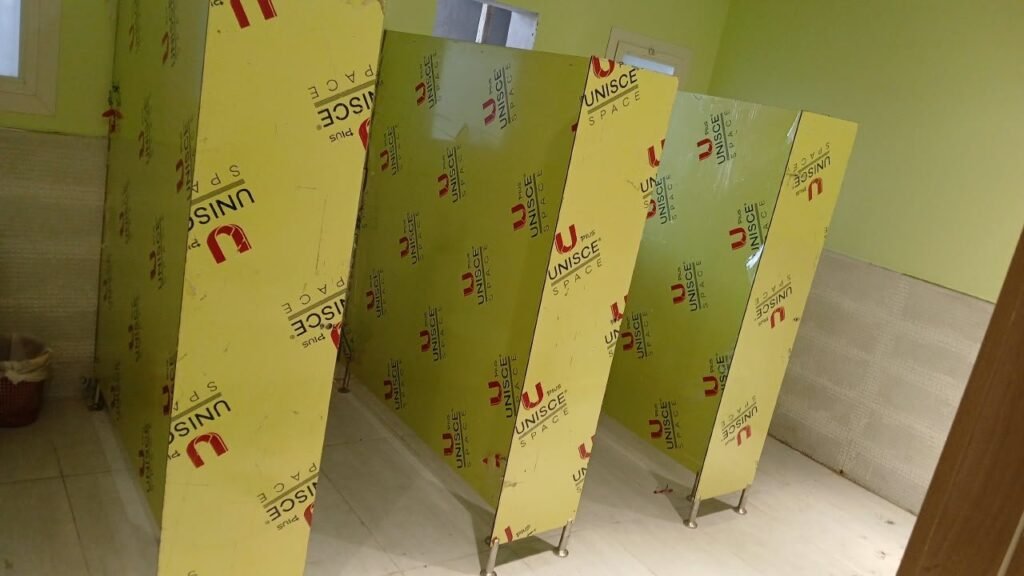
Nobody in this market prices the thing you are actually buying. You do not want fourteen square metres of panel. You want six cubicles that lock.
Here is how the arithmetic works on a standard WC cubicle at 1500 mm wide, 1500 mm deep and 2000 mm high, floor mounted.
- One door, roughly 0.6 by 2.0 m
- Two side dividers, roughly 1.5 by 2.0 m each
- One front pilaster
- Hardware set: two hinges, one indicator lock, one coat hook, two adjustable feet, head rail and brackets
That is roughly seven square metres of panel per cubicle before offcut, plus one hardware set, plus labour. Run it against the table above and you can sanity check any quote you have been given in about ninety seconds.
Where it gets cheaper: cubicles in a run share dividers. A bank of six does not need twelve dividers, it needs seven. Anyone quoting per cubicle without accounting for that is quoting lazily or quoting high.
What most quotes leave out
Check for these by name. They are the usual reason a number changes after you have committed.
- Delivery to site and floor access. A ninth floor with a small lift is not the same job as a ground floor loading bay.
- Cut outs and notching. Scribing a panel around an existing pipe or a column is machining time.
- Wall fixing substrate. Fixing into solid concrete is straightforward. Hollow block or drywall needs different anchors and sometimes a backing plate.
- Making good. Somebody has to patch the tile where the old partitions came out.
- Hardware brand, not just hardware material. Stainless covers a wide range of quality.
- Lead time. An imported colour that is not in stock is a container, not a warehouse pick.
- Removal and disposal of whatever is there now.
How thickness moves the number
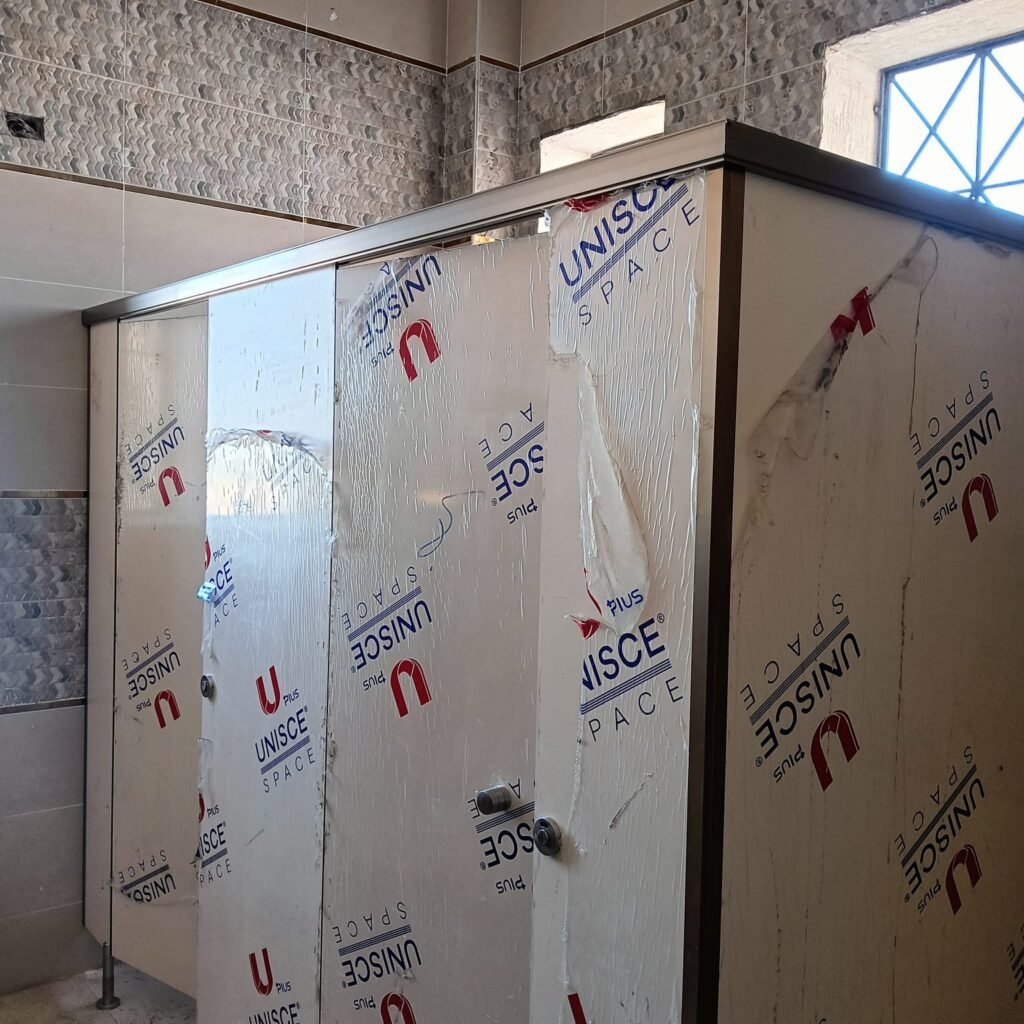
Every supplier in this market lists thickness as a price factor. None of them tell you the size of the step. So, plainly.
12 mm is standard. Offices, clinics, restaurants, schools and most commercial washrooms. It is rigid enough for a two metre door on good hardware and it is what the accessory ranges are machined for.
13 mm is the upgrade for heavy public traffic. The extra millimetre is not really about the panel failing. It is about door flex over years of being pushed rather than opened, and about the hinge having more material to bite into.
18 mm and above is worktop and vanity territory, not partitions. If someone quotes 18 mm cubicles they are either misunderstanding the job or padding it.
6 to 10 mm is cladding and locker territory.
The practical point: hinges and locks are machined for a specific panel thickness. Changing thickness after the hardware is ordered means changing the hardware. Fix the specification before anyone orders anything.
Reading a quote without getting caught
Six questions. Ask all six, in writing. A supplier who answers them without hedging is quoting a real job.
- Is this supply only or supply and installation?
- Where is the panel manufactured, and what is the brand?
- What thickness, and is the hardware machined for it?
- Is the hardware 304 stainless, on every item or only the visible ones?
- What is the lead time for this colour, and is it in stock in Egypt now?
- What is the warranty, on the panel and on the hardware separately?
One more thing worth knowing. A supplier who will not put the panel origin in writing is protecting a margin, not a trade secret. It is a reasonable question and it has a one word answer.
Common questions
Is compact HPL cheaper than Corian for bathroom partitions? Yes, substantially, for a cubicle application. Corian is a solid surface material that earns its price on seamless vanity tops and curved work, not on flat cubicle panels.
Can I buy the panels and have my own contractor fit them? You can, and some clients do. The risk sits in the machining. Panel edges, hinge cut outs and lock mortices need the right tooling, and a mistake on a cut sheet is not repairable.
Why will a supplier not give me a price over the phone? Because cubicle widths change the panel yield, and site conditions change the labour. A phone quote is either padded to cover the unknowns or it is going to move later.
Does the price include the hardware? Sometimes. In the Egyptian market accessories and installation are frequently quoted as a separate line at around 500 to 1,000 EGP per metre. Always ask which model the quote is using.
How long do compact panels last in a commercial washroom? With 304 stainless hardware and normal cleaning, the panel itself outlasts the hardware comfortably. Hinges and locks are the wear items and they are replaceable.
Do prices change with the exchange rate? Yes. The panel is imported, so a currency move feeds into the next container rather than into stock already in the warehouse. Ask whether a quote is held and for how long.
Get a price for your site
We supply and install compact panel partitions across Cairo, and we quote from drawings or from a site visit rather than from a guess. You get panel origin, thickness, hardware grade and lead time on the quote itself.
We work across the city, including commercial washrooms in New Cairo, projects in the New Administrative Capital, offices and clinics in Nasr City and factories and gyms in 6th of October. Full list on our home page.
كايرو هاوس – قواطيع حمامات كوريان و كومباكت HPL و ارضيات مرتفعة
Phone +201066672094
Email info@cairohouseeg.com
3 Misr Lel Tayaran Street, Block 1314, Civil Aviation Buildings, next to Sindbad, El Nozha El Gedida, Cairo